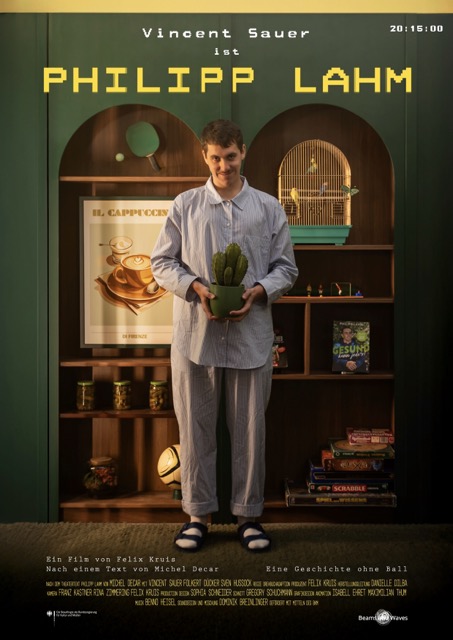
Coming soon …
Ist es das, was die Welt jetzt braucht: einen Film, bei dem am Anfang alles gut ist, in dessen Mitte alles gut ist und am Ende noch besser? Philipp Lahm hat die aufpeitschenden Dramaturgien alter, weißer Männer mit Leichtigkeit in den Staub gestoßen. Eine Satire und ein nostalgischer Rückblick auf, mit und über das eingeschlafene Deutschland der Angela Merkel-Zeit, das uns zudem gemacht hat, was wir heute sind.
// eng.:
Is this what the world needs right now: a film where everything is good at the beginning, everything is good in the middle, and everything is even better at the end? Philipp Lahm effortlessly swept the sensationalist narratives of old, white men into the dust. A satire and a nostalgic look back at, with, and about the complacent Germany of the Angela Merkel era—the very era that has made Germany who Germany is today.
Sign up here to stay updated on the latest news about the film.
/
Melde dich hier an, um über die neuesten Nachrichten zum Film auf dem Laufenden zu bleiben.
[for engl. down below]«Live fast, die young» war einmal. Der Rausch, der Exzess: vorbei. Deutschland in den Nuller- und Zehnerjahren des 21. Jahrhunderts, das ist die Ära der Fahrradhelme, Apfelsaftschorlen und Sparkassen-Apps. Wurde die Welt-Bühne früher von Kämpfen, Krisen und Konfrontationen erschüttert, angeleitet vom «Hetzer Aristoteles», dem weitere «konfliktgeile Dramaturgien toter Männer» folgten, dominieren heute Besonnenheit, Ausgleich und Harmonie. Kaum jemand steht für diesen Wandel symptomatischer als der Fußballer Philipp Lahm. Im gleichnamigen Film belauscht man seine Gespräche mit Journalisten, feiert mit ihm die größten Siege und geht mit ihm bei Burger King Mittagessen – stets maßvoll und vernunftgesteuert. Die Figur «Philipp Lahm» wird so zur Chiffre der Deutschen zur Zeit Angela Merkels, in einer Phantasmagorie über das durchschnittliche Leben. Philipp Lahm macht rigoros und witzig Ernst mit dem Drama, das längst nicht mehr stattfindet, und zeigt das Glück der Ereignislosigkeit, hinter dem jedoch womöglich ein neuer Abgrund lauert. (Eine Geschichte ohne Ball)
Spielfilm, experimentelle Zeitgeist Satire, 81 min.
[engl.]“Live fast, die young” is a thing of the past. The thrill, the excess: gone. Germany in the 2000s and 2010s is the era of bicycle helmets, apple juice spritzers and savings bank apps. Whereas the world stage was once shaken by struggles, crises and confrontations, led by ‘Aristotle the agitator’, followed by further ‘conflict-hungry dramas of dead men’, today prudence, balance and harmony dominate. Hardly anyone epitomises this shift more than the footballer Philipp Lahm. In the film of the same name, we eavesdrop on his conversations with journalists, celebrate his greatest victories with him and have lunch with him at Burger King – always in moderation and guided by reason. The character ‘Philipp Lahm’ thus becomes a cipher for the Germans in the era of Angela Merkel, in a phantasmagoria of average life. Philipp Lahm takes the drama—which has long since ceased to exist—seriously, rigorously and wittily, and reveals the happiness of uneventfulness, behind which, however, a new abyss may well be lurking. (A story without a ball)
Feature film, experimental zeitgeist satire, 81 mins.